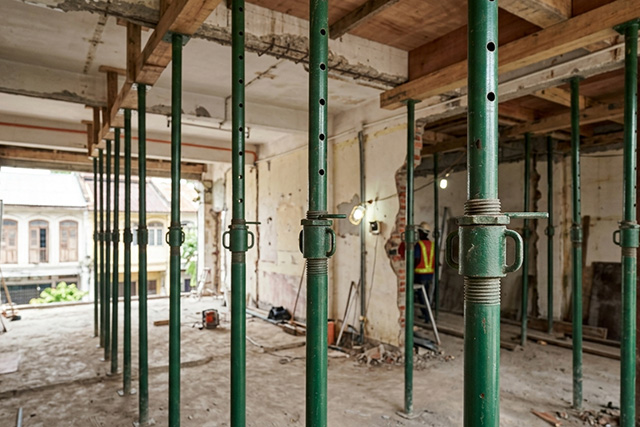
Malaysia’s ageing buildings are driving renovation demand. See how steel props keep structures safe during refurbishment work across Johor, Penang, and KL.
Key Takeaways
✨ Malaysia’s large stock of ageing urban buildings is creating a steady pipeline of renovation and refurbishment work, making temporary shoring an increasingly common on-site requirement.
✨ Steel props are adjustable, reusable temporary supports that keep structures stable when load-bearing elements are modified, removed, or replaced during renovation.
✨ Unlike new construction, renovation projects often involve working inside or around occupied or partially standing structures, making proper temporary shoring a critical safety measure.
✨ Steel props are suitable for a wide range of renovation scenarios, from shophouse refurbishments to commercial retrofits and structural repairs.
✨ Power Metal & Steel supplies scaffolding and steel products to contractors in Johor Bahru, Penang, Kuala Lumpur, and across Malaysia, with rental options available.
Introduction
There is something happening across Malaysia’s older urban neighbourhoods that does not always make the news but is becoming increasingly visible on the ground. Shophouses built in the 1970s and 1980s are being refurbished. Ageing flat blocks are being assessed for redevelopment. Commercial properties that have been standing for decades are getting structural upgrades to stay competitive and compliant. Renovation activity, once considered secondary to new construction, is quietly growing into a major segment of the construction industry.
For contractors working in this space, one question comes up often in practice: how do you keep a building safe while the work is happening inside it? The answer in many cases, starts with the steel prop.
What Is a Steel Prop and What Does It Do?
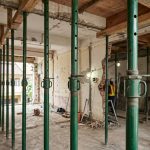
A steel prop, also known as an adjustable prop or shoring prop, is a telescopic steel post that provides temporary vertical support during construction or renovation work. It can be extended or compressed to fit different ceiling heights, and it is designed to hold up a beam, slab, or floor section while permanent supports are being modified, replaced, or installed.
The mechanics are straightforward. The inner tube slides inside the outer tube and a steel pin through aligned holes in both tubes sets the approximate height. A threaded collar nut is then turned to fine-tune the exact height and lock the prop firmly in position. Once positioned correctly under a load-bearing surface, it transfers the weight down to the floor or ground below. When the work is complete and permanent structural elements are back in place, the prop is removed.
What makes the steel prop particularly suited to renovation work is its adjustability and its compact footprint. On a site where you are working inside an existing structure rather than building from scratch, space is often limited. A prop can be set up and struck quickly by a small team, without heavy machinery or complex installation procedures.
Why Renovation Projects Create Genuine Shoring Demand
New construction tends to follow a predictable sequence. The structure goes up floor by floor, and temporary supports are used during concrete casting and curing before permanent strength develops.
Renovation work is less predictable. When you are modifying an existing building, you are often working around elements that are already carrying load. Removing a wall, cutting an opening, replacing a deteriorated beam, or upgrading a ground floor slab all require the load above to be safely supported while the work is happening.
In a shophouse renovation, for example, the upper floors may still be in use or structurally connected to the section being worked on. Propping the floor above before any structural work begins is a basic step, but it is one that matters enormously for the safety of workers and the stability of the surrounding structure.
This kind of work is exactly where steel props serve their core purpose.
The Renovation Context in Malaysia
Malaysia’s cities have been building steadily for decades, and a large portion of that building stock is now getting old. Properties constructed between the 1960s and 1990s in cities like Johor Bahru, Kuala Lumpur, Penang, and Ipoh were built for a different era. Many of them now need structural assessment, partial upgrading, or more substantial refurbishment to remain safe and functional.
This is not a niche situation. Ageing shophouses, older flat blocks, and commercial buildings across Malaysian urban centres are increasingly the subject of renovation work rather than outright demolition and rebuilding. Refurbishment is often more practical and more cost-effective, particularly for properties in established locations where land costs are high and the existing structure still has usable life.
For the construction industry, this means a steady flow of renovation-led work that sits outside the typical new-build project pipeline. Much of it is contractor-led, project by project, across individual buildings and blocks. And in the majority of these jobs, some form of temporary shoring is part of the scope.
Practical Considerations When Using Steel Props
A few things are worth keeping in mind when steel props are part of a renovation job.
Load assessment comes first. Before any propping is set up, the load being supported needs to be understood. Steel props come in different sizes and load ratings, and using the wrong prop for the weight involved is a safety risk. Knowing what you are supporting before mobilising saves time and prevents problems on site.
Correct placement matters. A prop that is not positioned directly under a load-bearing surface, or that is standing on an unstable base, will not perform as intended. The base needs to be solid and level. Where floor surfaces are uneven or weak, base plates help distribute the load across a wider area.
Inspect before reuse. Steel props are designed to be reused across multiple projects, which makes them a cost-effective option. But before reuse, every component should be checked. A bent inner tube, a damaged collar, or a cracked base plate should be a signal to take that prop out of service.
Follow proper strike-down procedure. When removing props after permanent works are completed, do so gradually and in a controlled manner. Avoid sudden releases or removing multiple props at the same time, as this can shift loads in ways that were not planned and create instability in the structure. Where multiple props are in use, the removal sequence matters and should be thought through before dismantling begins.
Power Metal & Steel: Steel Products and Scaffolding for Renovation Projects
At Power Metal & Steel, we supply scaffolding and steel products to contractors working on construction and renovation projects across Malaysia. Our inventory includes both new and reconditioned stock, giving contractors practical options to match different project budgets.
We serve clients in Johor Bahru, Penang, Kuala Lumpur, and surrounding areas, with rental and purchase options available. Whether a project calls for scaffolding access equipment or steel product supply, our team can help you plan what you need and get it to site.
If you are working on a renovation project and want to discuss your requirements, reach out to our team for a consultation.
FAQs
A steel prop is a single adjustable vertical post used to provide temporary support directly under a load-bearing surface such as a beam, slab, or floor. Scaffolding, on the other hand, is a broader structural system of frames, tubes, and platforms that gives workers safe access to work at height across larger areas of a building. The two serve different purposes: steel props are primarily about keeping a structure stable during renovation or construction, while scaffolding is about providing a safe working platform. On some renovation projects, both may be needed at the same time for different functions.
Steel props are manufactured in different sizes covering different height ranges, and each size has a rated load capacity that indicates the maximum load it is safe to support. The right prop for a job depends on the height of the space being propped and an estimate of the load being transferred, which includes the weight of the floor, any materials stored on it, and any live loads from workers or equipment above. For renovation projects where the structural loads are uncertain or where multiple floors are involved, consulting a structural engineer before selecting and installing props is the most reliable way to make sure the right equipment is used.
Yes, steel props can be used on outdoor sites or in environments exposed to rain and humidity, which is a common condition on Malaysian construction and renovation sites. However, exposure to moisture accelerates surface corrosion over time, so props used in wet conditions should be inspected more frequently for rust and surface degradation. Components that show significant corrosion, particularly around threaded sections or pin holes, should be assessed carefully before reuse, as corrosion can reduce the effective load capacity of the prop even when the external structure still appears intact.
There is no specific licence required purely to purchase or rent steel props as a product. However, the way they are used on site falls under general occupational safety and health requirements in Malaysia, which place responsibility on contractors and site supervisors to ensure that temporary support systems are set up and managed safely. This means that while procurement itself does not require special certification, the people overseeing and installing the props on site should have the knowledge and training to do so correctly. Contractors sourcing from a reputable supplier can also consult with their supplier on appropriate equipment selection for the job.
Key warning signs include a prop that is visibly leaning rather than plumb vertical, a base plate that has sunk into or cracked the surface beneath it, a collar nut that has become loose during the course of the work, or any visible bending or buckling of the tube under load. A prop that makes unexpected creaking or shifting sounds when load is applied should also be treated as a concern. Any of these conditions should prompt an immediate stop to work in the affected area and a reassessment of the prop setup before activities continue.