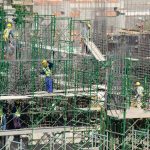
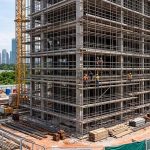
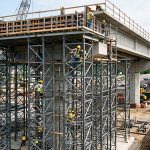
Bridges and flyovers demand a different approach. See how modular scaffolding Malaysia is being specified for falsework on infrastructure projects nationwide.
Key Takeaways:
- Malaysia’s infrastructure pipeline, including rail links, flyovers, and highway upgrades, is generating steady demand for modular scaffolding used as temporary falsework.
- Bridge and flyover construction involves engineering demands that differ from building work, including cantilever loads during deck construction and clearance requirements above rivers or live traffic.
- Modular scaffolding systems are often specified for falsework because their configuration can be adapted around piers, abutments, and irregular site conditions more readily than fixed structures.
- Falsework design for infrastructure projects should always be confirmed by a qualified structural engineer, since load paths and clearance requirements vary significantly between sites.
- Power Metal & Steel supplies scaffolding and shoring systems suited to infrastructure and civil engineering projects across Johor, Penang, Kuala Lumpur, and other parts of Malaysia.
Introduction
Malaysia’s infrastructure sector is entering a genuinely active period. The Johor Bahru to Singapore Rapid Transit System is targeted for completion by the end of 2026, the East Coast Rail Link is progressing toward a similar timeline, and the Penang LRT Mutiara Line remains an active, ongoing project. Beyond these headline projects, highway upgrades and flyover works continue across the country as part of the broader push to improve connectivity between urban centres.
For contractors delivering this kind of work, one thing becomes clear quickly. Bridge and infrastructure construction places very different demands on temporary works compared to a typical building project. This is exactly the kind of demand that modular scaffolding Malaysia projects increasingly rely on, and it is worth understanding why.
Why Is Bridge Construction Different From Building Construction?
A building rises from the ground floor upward, generally supported by a growing structure directly beneath it. A bridge or flyover does not follow the same logic.
During deck construction, sections of the structure often extend outward from a support point before the far end has anything solid beneath it. This creates cantilever loads, where a beam or slab is carrying weight while only supported at one end. Managing this kind of load safely is central to how temporary works are planned on bridge projects.
There is also the matter of what sits beneath the structure. A building’s scaffold typically stands on solid ground. A bridge under construction is frequently positioned above a river, a road that remains open to traffic, or a rail corridor that cannot be closed for extended periods. Falsework towers supporting the structure need to account for this clearance, both in terms of physical height and the practical reality of working above an active waterway or roadway.
What Role Does Modular Scaffolding Play in Falsework?
Falsework refers to the temporary structure that supports a bridge, flyover, or similar structure during construction, before the permanent structure becomes self supporting. Modular scaffolding systems have become a common choice for this application, largely because of how they can be configured.
Unlike a building site, where scaffold layouts often repeat across similar floor plates, bridge sites tend to be irregular. Piers and abutments are positioned according to the engineering design of the crossing, not according to a standard grid. Modular scaffolding components can be adjusted in height, spacing, and configuration to work around these fixed points, which makes them more practical than rigid or custom-fabricated support structures for many falsework applications.
Modular systems also support the phased nature of bridge construction. As one section of deck is completed and the falsework beneath it is no longer needed, that section can often be struck and reconfigured for use further along the structure, rather than requiring an entirely new setup at every stage.
How Do Clearance Requirements Affect Falsework Planning?
Clearance is one of the more site-specific aspects of infrastructure falsework, and it varies significantly depending on what the structure crosses.
Above a river, falsework towers need to account for water levels, which can rise during periods of heavy rain, as well as any requirement to maintain navigation clearance for river traffic. Above a road, falsework needs to be planned around maintaining safe clearance for vehicles passing beneath, often while traffic continues to flow during construction. Above a rail corridor, clearance planning becomes even more constrained, given the operational requirements of the rail line itself.
These clearance requirements are not something a contractor should estimate informally. They are determined through the structural design process, in coordination with the relevant authorities responsible for the river, road, or rail corridor involved. The role of the falsework contractor is to build to the confirmed clearance and load requirements set out in that design.
Why Should Falsework Design Always Involve a Structural Engineer?
Because bridge and flyover falsework carries loads that shift as construction progresses, and because the consequences of a failure are considerably more serious than on a typical building site, falsework design should always be confirmed by a qualified structural engineer before erection begins.
This is not a step that scaffolding suppliers or contractors should skip or assume has already been handled elsewhere. Load calculations, clearance confirmations, and the sequence in which falsework is erected and struck all need to be engineered specifically for each crossing, taking into account the particular geometry, span, and site conditions involved.
A scaffolding supplier’s role in this process is to provide equipment suited to the confirmed design, with components that can be configured to match the engineer’s requirements, rather than to make those engineering decisions independently.
Power Metal & Steel: Supporting Infrastructure and Civil Engineering Projects
At Power Metal & Steel, we supply modular scaffolding and heavy duty shoring systems, including our C60 shoring system, to contractors working on infrastructure and civil engineering projects across Johor Bahru, Penang, Kuala Lumpur, and other parts of Malaysia. Our equipment is suited to the kind of adaptable, load-bearing applications that bridge and flyover falsework demands.
As Malaysia’s infrastructure pipeline continues to move forward, having a scaffolding partner who understands the practical differences between building work and civil engineering work matters. If your project involves falsework for a bridge, flyover, or similar structure, our team can work with your engineering design to supply the right configuration of equipment.
Get in touch with us to discuss your infrastructure project’s scaffolding and shoring requirements.
FAQs
Falsework is a temporary structure designed to bear the load of a structure under construction, such as a bridge deck, until it becomes self supporting. General access scaffolding, by contrast, is primarily designed to give workers safe access to work at height rather than to carry structural load, which is why the two serve fundamentally different purposes on site.
Modular scaffolding is widely used, but it is not the only method. Some bridge projects use custom engineered falsework systems, particularly for very long spans or unusual geometries, so the choice ultimately depends on the specific structural design and site conditions confirmed by the project’s engineer.
The structural engineer determines the falsework design, including load paths, clearance requirements, and erection sequence, based on the specific bridge or flyover being built. The contractor and scaffolding supplier are then responsible for constructing the falsework to match that confirmed design, rather than making independent configuration decisions.
The same modular scaffolding product range can often be used across both applications, but the way it is configured differs significantly based on the load and clearance requirements involved. Readers exploring how modular systems are applied more broadly may find our overview of modular scaffolding for construction projects useful for comparison.
In many cases, yes, since modular falsework components are designed to be dismantled and reconfigured for use at the next pier or span once a section is complete. This reuse is one of the practical advantages of modular systems on longer bridge projects with multiple similar spans.