Why are Malaysian main contractors moving away from supply only scaffolding? See how dismantle and erection services are reshaping project safety and contracts.
Key Takeaways
✨ Main contractors in Malaysia are increasingly requiring their scaffolding suppliers to provide certified dismantle and erection services rather than equipment supply alone.
✨ This shift is being driven by tighter safety enforcement and contracts that place clearer responsibility on parties involved in temporary works.
✨ Supply only arrangements leave gaps in accountability when scaffolding is assembled by workers who are not specifically trained or certified for the task.
✨ Suppliers who offer trained crews for dismantle and erection, alongside proper inspection documentation, are becoming the preferred choice for main contractors managing project risk.
✨ Power Metal & Steel provides dismantle and erection services carried out by trained scaffolders in the Johor area, alongside scaffolding rental and supply, for projects across Johor, Penang, Kuala Lumpur, and other parts of Malaysia.
Introduction
For years, a common arrangement on Malaysian construction sites was straightforward. A main contractor would rent or buy scaffolding from a supplier, and the contractor’s own workers, or a separate subcontractor, would handle putting it up and taking it down. The supplier’s job ended once the equipment arrived on site.
That arrangement is changing.
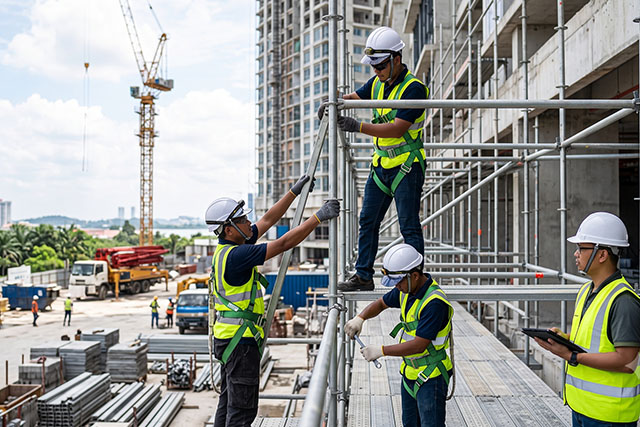
Across Malaysia, more main contractors are now requiring their scaffolding suppliers to provide dismantle and erection services as part of the package, carried out by trained and certified scaffolders rather than general site labour. This is not a small shift. It reflects a broader change in how project risk, safety accountability, and contract structure are being approached on construction sites.
What Is Driving This Shift
A few forces are converging to push this change forward.
Safety enforcement in Malaysia has become more rigorous in recent years. Construction remains one of the higher-risk industries for workplace incidents, and scaffolding related failures are a recurring theme in site safety cases. As enforcement authorities tighten inspections and increase scrutiny of temporary works, the consequences of a poorly assembled or improperly dismantled scaffold have become more serious, both in terms of safety outcomes and legal exposure.
At the same time, project contracts themselves are evolving. Main contractors are increasingly structuring agreements so that responsibility for temporary works, including scaffolding, is clearly assigned rather than left ambiguous. When a scaffold failure occurs, the question of who was responsible for its erection and inspection matters enormously, both for safety investigations and for any liability that follows. A supply only arrangement, where the equipment comes from one party and the erection is handled by another, creates exactly the kind of ambiguity that main contractors are now trying to avoid.
There is also a practical dimension. Scaffolding erected by workers without specific training in scaffold assembly carries a higher risk of being incorrectly configured, whether through missing bracing, inadequate ties, or components that are not properly secured. Certified scaffolders bring a level of consistency and accountability that general labour, however capable, may not always provide.
What This Means for Project Safety Outcomes
When erection and dismantling is handled by trained, certified scaffolders working for the supplier who also provided the equipment, several things tend to improve.
There is a single point of accountability. If a question arises about how a scaffold was assembled, there is no ambiguity about who was responsible, which supports faster resolution and clearer safety records.
There is more consistency between the equipment and the people assembling it. A scaffolder who works regularly with a specific supplier’s systems understands the components, connection methods, and configuration requirements of that equipment more thoroughly than a general labour team encountering it for the first time.
There is also better documentation. Suppliers offering certified erection services typically provide inspection records and handover documentation as part of the process, which supports the kind of safety paperwork that main contractors increasingly need to demonstrate compliance during site audits or after an incident.
How This Is Changing Scaffolding Contracts on Site
The practical effect of this shift is visible in how scaffolding contracts are now being structured. Rather than treating equipment supply and erection as two separate line items, or two separate vendors entirely, more main contractors are consolidating both under a single scaffolding contractor relationship.
This has a few implications for how projects are planned. Main contractors are asking suppliers upfront whether they offer trained erection crews, not just equipment. They are requesting proof of scaffolder training or certification as part of the vendor selection process. And they are building erection and dismantling timelines into the overall project schedule as a coordinated activity, rather than assuming it will simply happen once equipment is delivered.
For scaffolding suppliers in Malaysia, this means the ability to offer genuine erection and dismantling capability, backed by trained personnel, has become a meaningful point of differentiation rather than an optional add-on service.
What to Look for When Choosing a Scaffolding Partner
For main contractors navigating this shift, a few things are worth confirming when evaluating a scaffolding supplier.
Trained and experienced scaffolders. Ask whether the crew assembling and dismantling the scaffold have specific training and experience in scaffold erection, not just general construction experience.
Inspection and documentation practices. A supplier who provides clear records of scaffold inspections and handover checks makes it easier to maintain proper safety documentation throughout the project.
A single point of contact. Working with one supplier for both equipment and erection reduces the coordination gaps that can occur when responsibility is split across separate vendors.
Familiarity with the specific equipment. Scaffolders who regularly work with the same systems tend to assemble them more consistently and efficiently than crews encountering unfamiliar components for the first time.
Power Metal & Steel: Dismantle and Erection Services in Johor
At Power Metal & Steel, we provide dismantle and erection services carried out by trained scaffolders for contractors working in the Johor area, alongside our scaffolding rental and supply for contractors working across Johor Bahru, Penang, Kuala Lumpur, and other parts of Malaysia. Our approach reflects exactly the shift discussed above, offering equipment and installation as a coordinated service rather than two disconnected arrangements.
As main contractors continue to prioritise accountability and safety documentation on their projects, having a scaffolding partner who can support both the equipment and the people assembling it gives project teams one less variable to manage.
If your project is based in Johor and requires dismantle and erection services alongside scaffolding supply, get in touch with our team to discuss your requirements. For projects outside Johor, our team can still assist with scaffolding rental and supply.
FAQs
A dismantle and erection service covers the physical assembly and later disassembly of the scaffold structure on site, carried out by trained scaffolders rather than the main contractor’s general workforce. It typically also includes inspection checks before handover and proper documentation confirming the scaffold has been assembled correctly and is ready for safe use.
Main contractors can request documentation of scaffolder training or certification directly from the supplier before work begins, along with details of the crew’s relevant experience. Asking for inspection records from previous projects can also help confirm that the supplier consistently follows proper erection and handover practices.
Costs vary between suppliers and project scope, so this is best confirmed directly through a quotation. However, many main contractors find that consolidating equipment and erection under one supplier reduces coordination overhead and potential rework costs that can arise from miscommunication between separate vendors.
A proper handover usually involves a joint walkthrough of the completed scaffold, checking that bracing, ties, platforms, and access points meet the required configuration. The erection crew typically provides documentation confirming the inspection has been completed, giving the main contractor a clear record before the scaffold is put into use.
Responsibility in such cases depends on the specific contractual arrangements and the circumstances surrounding the failure, and is typically determined through a safety investigation. This is precisely why many main contractors now prefer arrangements where erection responsibility is clearly assigned to a single, accountable party from the outset.