Building a factory or industrial facility in Malaysia? See why scaffolding rental Malaysia is helping contractors stay fast, flexible, and compliant.
Key Takeaways:
✨ Industrial and manufacturing plant construction in Malaysia runs on tight timelines, and scaffolding rental helps contractors keep pace without waiting on owned equipment.
✨ Renting shifts a meaningful share of equipment compliance responsibility onto the supplier, who is expected to provide scaffolding that meets required standards.
✨ Factory builds move through distinct phases, including groundworks, structural frame, cladding, and MEP installation, each with different scaffolding needs that rental can flexibly support.
✨ Contractors managing several factory builds across Malaysia’s industrial zones benefit from being able to scale rented equipment up or down per site rather than being tied to fixed owned stock.
✨ Once a project closes, rented scaffolding is simply returned, removing the ongoing storage and maintenance burden that comes with ownership.
Introduction
Malaysia’s industrial base keeps expanding. From Johor’s Iskandar corridor to Penang’s electronics manufacturing belt and the Klang Valley’s logistics hubs, factory and plant construction is a constant feature of the country’s development pipeline. For contractors delivering these projects, speed, flexibility, and compliance all matter more than they might on a typical commercial build.
This is exactly where scaffolding rental Malaysia has become a practical answer for industrial and manufacturing plant construction. Here is why.
Why Does Speed Matter So Much on Factory Builds?
Industrial and manufacturing clients often work backward from a fixed operational date. A production line that needs to start running by a certain quarter puts real pressure on every phase of construction leading up to it, and scaffolding is no exception.
Owning scaffolding outright means a contractor is limited to whatever quantity they already have on hand. If a factory project needs more scaffold than what is currently available, sourcing and mobilising additional owned equipment takes time that a tight schedule may not allow.
Renting removes this constraint. A contractor can request exactly the quantity and configuration needed for a specific factory build, scaled to the project’s actual timeline, without waiting on internal procurement or equipment transfers from another site. For fast-moving industrial projects, this kind of responsiveness often makes the difference between staying on schedule and falling behind before the structural phase even begins.
Who Carries the Compliance Burden When Scaffolding Is Rented?
Compliance is a real consideration on any Malaysian construction site, and scaffolding is no exception. Scaffolding materials fall under CIDB’s regulated product requirements, and equipment used on site should carry proper standard compliance certification confirming it meets the relevant national standards.
When a contractor rents scaffolding rather than owning it, a meaningful part of that compliance responsibility shifts to the supplier. A reliable rental provider is expected to maintain and inspect their stock, ensuring that what arrives on site is certified and fit for use. This reduces the burden on the contractor’s own team, who would otherwise need to track certification status, inspection schedules, and maintenance records across an owned equipment fleet on top of everything else a factory build already demands.
How Does Scaffolding Rental Support Multi-Phase Industrial Construction?
A factory or manufacturing plant is rarely built in one continuous, uniform stage. It typically moves through several distinct phases, and each one places different demands on scaffolding.
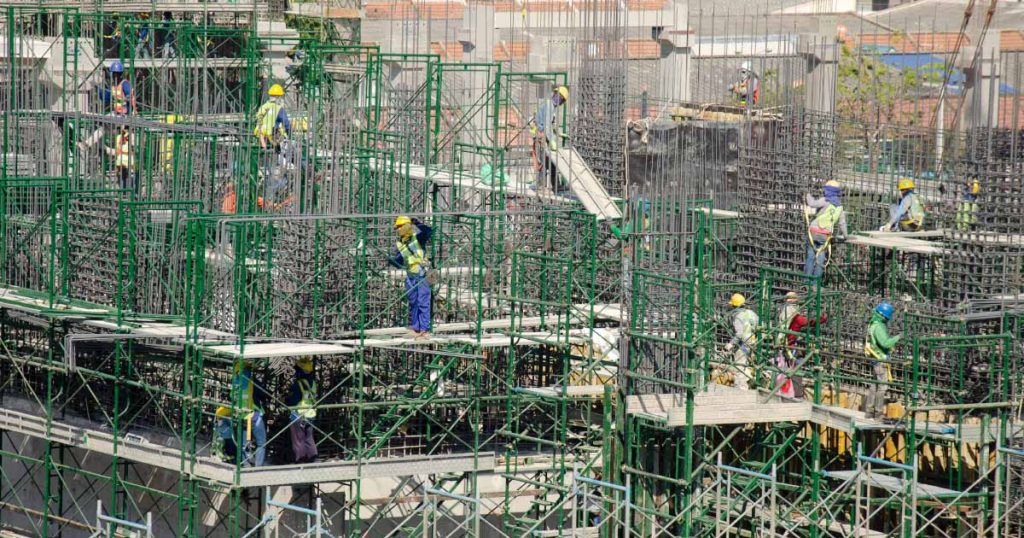
Groundworks and foundation stages may need minimal scaffold, focused mainly on access for smaller structural elements. As the structural frame goes up, scaffolding needs increase significantly to support work at height across a growing footprint. Cladding installation often requires scaffold arrangements suited to exterior access around the building envelope. Later, MEP installation, covering mechanical, electrical, and plumbing systems, tends to require scaffold access focused on specific interior zones rather than the whole structure.
Rental fits this phased reality well. Contractors can adjust the type and quantity of scaffolding as the project moves from one phase to the next, rather than being stuck with a fixed configuration that was suited to an earlier stage but no longer matches current needs. Systems such as the C60 shoring system are particularly useful during structural phases involving concrete work, while more standard frame or tubular setups often suit cladding and MEP access needs better.
Can Scaffolding Rental Scale Across Multiple Industrial Sites?
Contractors working in Malaysia’s industrial construction space often have more than one project running at a time, particularly across established zones like Johor’s industrial corridors, Penang’s manufacturing belt, or the Klang Valley.
Owning a fixed quantity of scaffolding makes this kind of multi-site operation harder to manage efficiently. Equipment has to be split, moved, or prioritised between sites, and a shortage at one location can stall progress while stock sits unused elsewhere. Renting allows each site to be resourced according to its own actual requirements, drawing from a supplier’s broader stock rather than a single fixed inventory the contractor has to stretch across every active project.
This scalability becomes especially valuable when a contractor wins a new factory project in a location where they have not previously worked, since rental removes the need to relocate owned equipment over long distances before work can begin.
What Happens to Rented Scaffolding Once a Project Closes?
One advantage of rental that is easy to overlook is what happens after the project ends. Owned scaffolding does not simply disappear once a factory build is complete. It needs to be stored, maintained, and eventually redeployed or disposed of, all of which carries ongoing cost and operational effort.
With rental, this responsibility does not fall on the contractor. Once the project closes, the equipment is returned to the supplier, who takes on the storage, inspection, and maintenance between projects. For contractors managing a pipeline of industrial projects rather than a single build, this removes a layer of overhead that would otherwise accumulate with every completed factory.
Our tubular scaffolding systems and frame scaffolding options are available for rental across a range of industrial project types, giving contractors the flexibility to match equipment to each phase without carrying that equipment as a long-term asset once the work is done.
At Power Metal & Steel, we supply and rent scaffolding to contractors building industrial facilities and manufacturing plants across Johor, Penang, Kuala Lumpur, and other parts of Malaysia. If your next factory project is in the planning stage, our team can help you work out the right scaffolding approach for each phase before mobilisation begins.
FAQs
Standard scaffolding rental typically covers certified, inspected equipment, with the supplier responsible for ensuring the stock meets required standards before it leaves their yard. Erection and on-site installation are usually separate services, so contractors should confirm with their supplier whether these are included or arranged independently, as explained in our guide to erection and dismantling services.
Planning usually starts by mapping out the project programme and identifying which phases, such as structural frame, cladding, or MEP installation, require scaffold and what type suits each stage. Coordinating this with the rental supplier early allows equipment to be adjusted and delivered in step with the construction schedule rather than reactively.
Most rental arrangements allow the rental period to be extended if a project runs longer than originally planned, though this should be communicated with the supplier as early as possible. Confirming extension terms at the start of the rental helps avoid unexpected gaps in equipment availability.
In most cases, yes, since rental quantities and configurations can generally be adjusted as project needs evolve, subject to the supplier’s available stock at the time. This flexibility is one of the practical advantages of rental compared to being limited to a fixed amount of owned equipment.
Coordinating multiple sites usually involves working with a single supplier who can allocate stock across projects based on each site’s current phase and urgency. This centralises communication and reduces the risk of one site being under-resourced while another has unused equipment sitting idle.